What is an agentic CMMS?


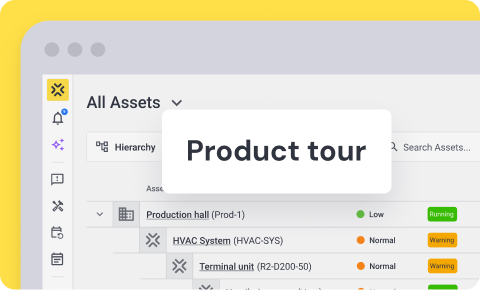
An agentic CMMS is maintenance software in which AI agents handle routine work themselves: they prepare schedules, write completed jobs into the system, and pre-sort incoming work requests. Nothing goes live until a human has reviewed and approved it. The difference from a classic CMMS: a classic CMMS documents maintenance work. An agentic CMMS does part of it for you. Specifically the part that happens away from the asset: the searching, the writing, the scheduling.
On terminology: CMMS stands for computerised maintenance management system, so agentic CMMS and agentic maintenance software describe the same category.
The problem: only 30% of the day at the asset
Digitisation never solved maintenance's core problem. Only about 30% of a maintenance working day happens at the asset: turning wrenches, replacing parts, measuring, adjusting. Maintenance teams call that time wrench time. The rest of the day is everything around it: searching, walking, writing, phoning.
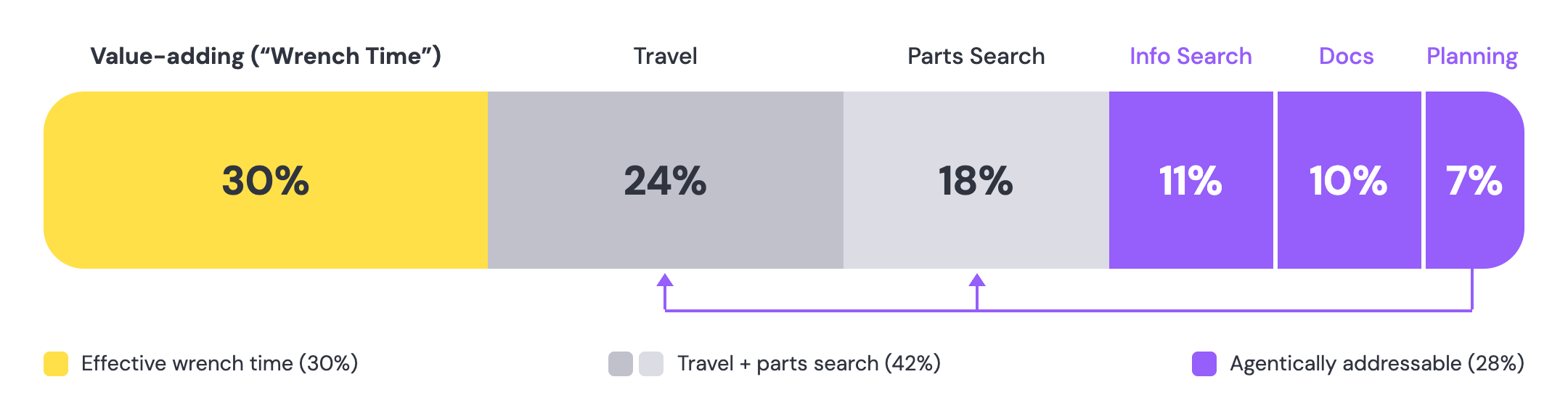
Where exactly does that time go? The big blocks are measured: industry analyses by ReliablePlant put numbers on wrench time, travel and parts searching. The smaller blocks, meaning information search, documentation and scheduling, are estimates from the field.
Rounded, a typical day looks like this: travel to and from the asset takes 24%, searching for spare parts 18%, hunting for schematics, history and manuals 11%, writing up documentation 10%, and building the schedule by hand 7%. The shares shift from plant to plant. The pattern doesn't.
A classic CMMS digitised all of this without shrinking it. The paper form became an input mask. People who used to write now type. The 70% stayed. And operations pay for it twice: once as a technician hour, once as downtime that drags on because that hour didn't happen at the asset.
In conversation with David Hahn, CEO of remberg
Modern software made maintenance more structured and easier to use. Wrench time barely moved. Here David Hahn, CEO of remberg, explains why, and what agents change about it.

Maintenance software has been around for years. What is different today?
“Modern software got a lot right. Data sits in one place instead of five folders, processes are structured, and the interface is finally simple enough for the shop floor. That was real progress, and we build on it. But the one number that matters has barely moved: a technician still spends only about a third of the day at the asset. We digitized the desk work. We did not take it off their plate.”
And an agent changes that?
“An agent takes over the work nobody enjoys: the searching, the typing, the chasing people on the phone. When that falls away, there is more time for what these people actually trained for, which is the machine. This is not only an efficiency story. A technician who no longer spends an hour on documentation in the evening goes home happier. And when every skilled worker is hard to find, that counts for a lot.”
Where are we in this shift?
“At the beginning, honestly. The technology is here, the first plants are working productively with it, but most of the industry is just getting started. The principle stays the same no matter how good the models get: the agents act, the human decides. Maintenance will be done by people for a long time. We just make sure they spend their time where it counts.”
Where is the time actually lost?
Two things stand out in that breakdown.
First: 42% of the day, the travel and the parts searching, is mostly the result of thin planning. Walk out, part's missing, walk back. No software can remove the walk to the asset." No software can remove the walk to the asset. Good planning makes it rarer.
Second: 28% of the day, the information search, the documentation and the scheduling, is desk work. That is exactly what software can take over. This is the scope of the category, deliberately no more.
And the two are connected. David Hahn, CEO of remberg, puts it as a rule of thumb: "One hour of planning saves around three hours of execution. Raise the planning rate from 30 to 80 percent and productive time doubles." The rule of thumb comes from Doc Palmer's Maintenance Planning and Scheduling Handbook, the standard reference on maintenance planning; the planning-rate figures from Sockeye's analyses. An agent that prepares the schedule properly doesn't just save the 7% spent on planning. It also cuts the driving and the searching.
What does an agentic CMMS actually do?
Three use cases define the category today.
1. Work requests arrive complete. Today a fault arrives as a phone call during lunch, as half an email, or not at all. With an agentic CMMS, whoever is standing at the machine scans a QR code, describes the fault in their own language ("pump P-04 is leaking at the seal"), and attaches a photo. The agent works out which asset it is, translates for the team, and proposes an order type, a priority and an assignment. Maintenance gets a finished request instead of a puzzle.
2. Report by voice, not keyboard. Nobody enjoys writing job reports, least of all in the office hours after the job. With an agent, the technician just speaks the report into a phone. The agent sorts what was said into the right fields: what was done, how long it took, which materials, what the findings were. If something is missing, it asks. The knowledge stays in the system instead of eventually retiring with your most experienced people.
3. The plan is ready every morning. The agent builds a planning proposal from maintenance plans and open requests, and not just the schedule. It assembles the right work steps from the history of comparable orders, checks ahead of every planned job whether the needed spare parts are available, and automatically raises a purchase requisition when stock is short. Only then does it match jobs to skills, availability and timing. The planner reviews, adjusts, approves. Instead of assembling the board by hand, planners just decide.
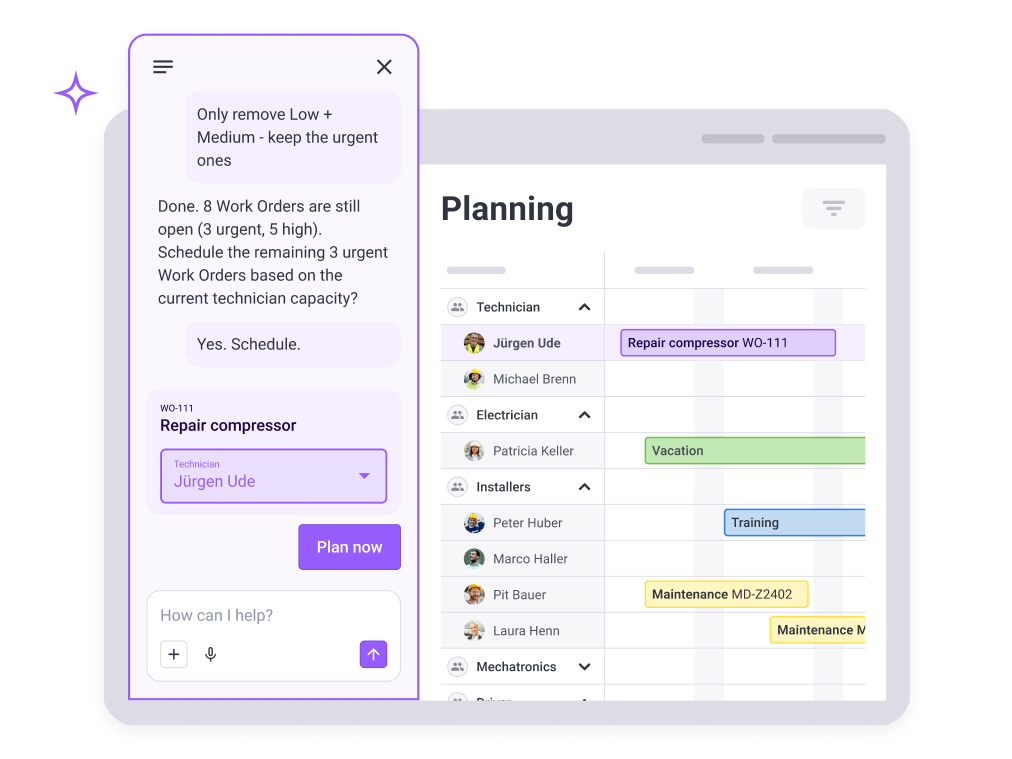
The pattern is the same in all three: the agent executes, the human stays the final authority. No work order runs without approval, no priority gets set without review.
What an agentic CMMS is not
The boundaries are part of the definition. Without them, the term collapses into a buzzword.
Not a chatbot. A chatbot or copilot answers questions and drafts text. That helps, but the work is still sitting there: after the answer, someone still has to type. An agent completes the step itself and submits the finished result for approval. The test is simple: is there still typing left after the AI answers? Then it was a chatbot, not an agent.
Not autonomous maintenance. No agent turns a wrench or makes calls where safety is on the line. Agents take over the work around the asset, not the work at it.
Not predictive maintenance. Predictive maintenance forecasts failures from sensor data. That is its own discipline with its own prerequisites, sensors above all. An agentic CMMS needs none. It works with what every maintenance team already has: requests, work orders, history, documents.
How to tell a real agentic CMMS from an AI label
Four questions separate agentic maintenance software from an AI label on old software:
- Does it do the work or just assist? Does the system deliver finished results for approval, meaning a pre-sorted request, a filled-in job report, a scheduling proposal? Or does it just answer questions?
- Where does the agent sit? Inside the core processes, meaning requests, work orders and scheduling? Or next to them, as a chat window?
- Does the human stay the final authority? Proposing and approving must be separate, and every approval must be traceable later.
- Is it extensible? Can your own team teach the agents new tasks, or is the scope hard-wired?
What do AI agents need to work reliably?
Across buyer conversations, three conditions come up again and again. None of them is fear of AI. All three are operational requirements.
- Where does the data live? And where do the AI models run? For European industry that typically means EU hosting, GDPR, and ISO 27001 or BSI C5 depending on the sector.
- Who decides? Agents propose, humans approve. Not as a transition phase until the AI is good enough, but as a principle built into the architecture.
- Is the data good enough? Agents are only as good as the master data, history and documents they work with. An agentic CMMS therefore needs an honest look at your data quality, and clean migration paths from SAP PM and legacy systems.
The second condition is the one to remember, and it fits in a single sentence: "The agents act, but the human decides." says David Hahn, CEO of remberg.
Common questions about agentic CMMS
Is an agentic CMMS the same as an AI CMMS? Not quite. AI CMMS usually describes maintenance software with AI features layered on top: search, chat, text suggestions. Those features assist. An agentic CMMS executes: it completes defined work steps on its own and submits the result for approval. Every agentic CMMS is an AI CMMS. The reverse is not true.
Does an agentic CMMS replace maintenance technicians? No. It shifts time from documentation, searching and coordination back to the asset. When 70% of the day happens away from the asset and skilled workers are scarce, the goal isn't fewer people. It's more wrench time per person. Or as David Hahn puts it: "People aren't going away. Maintenance will be done by humans for a long time to come. Even if robots end up doing everything, someone still has to maintain the robots."
What's the difference between a CMMS with AI features and an agentic CMMS? AI features help you work: they answer questions, suggest text, improve search. An agentic CMMS completes defined work steps itself and submits the results for approval. The line runs between "helps me type" and "I no longer type."
How mature is the category? In the US, agentic capabilities are shipping product, not vision. According to the 2026 State of Industrial Maintenance report (2,234 respondents, US and Canada), 59% of AI-using operations already use or pilot agents. In May 2026, Autodesk announced the acquisition of MaintainX for approximately $3.6 billion, the clearest signal yet that maintenance software has become strategically significant. Europe is an estimated one to two years behind, and the category is still largely unclaimed.
Do I need a new system alongside SAP PM? Not necessarily. The common architecture is an add-on that keeps master and transactional data in sync with SAP. The shop floor works in the agentic system, and SAP remains the leading system for finance and compliance.