Breitenfeld Edelstahl
How Breitenfeld Edelstahl makes its maintenance team’s work visible
- Company Breitenfeld Edelstahl AG
- Industry High-grade and special steel
- Site St. Barbara-Mitterdorf, Styria, Austria
For a long time, maintenance work at Breitenfeld Edelstahl was barely documented. With remberg, both the management board and the team itself can now see what the roughly 60 people in Sandro Pesendorfer’s department get done every day.

Challenge
- Maintenance work was barely documented and mostly got noticed when something broke down
- Electricians on older software that didn’t work on mobile, fitters on paper
- Much of the work was reactive and hard to plan

Outcome
- Everyone reports faults via QR code, with no user account and no download
- Work is documented right at the asset, with photos and spare parts
- The board and the team can see what maintenance gets done every day

A steel mill that runs to the rhythm of its arc furnace
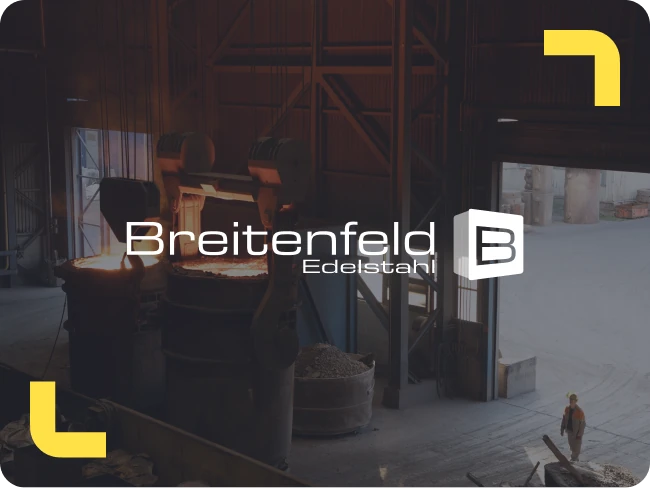
Breitenfeld Edelstahl makes high-grade and special steel in the Mürz Valley in Styria, producing it exclusively in an electric arc furnace. The company employs around 350 people in Austria. The mill turns out ingots, remelted ingots and forged bar for sectors including power generation, aviation and mechanical engineering. The furnace sets the pace: when there is a problem there, it soon ripples through every process, all the way to dispatch. Making sure that happens as rarely as possible is the job of Sandro Pesendorfer and the roughly 60 people in Central Maintenance.
Most heats are tapped at between 1,700 and 1,760°C, and the hottest reach as much as 1,800°C. That puts heavy demands on people and equipment alike. If refractory material fails, molten steel escapes, and a simple fault quickly becomes a safety issue. It is rarely possible to predict when that will happen, so a good part of the work is reactive. Even so, nobody panics when something breaks down. For the team, it is just part of the job, and they feel quite comfortable in what Pesendorfer calls “firefighting mode”.
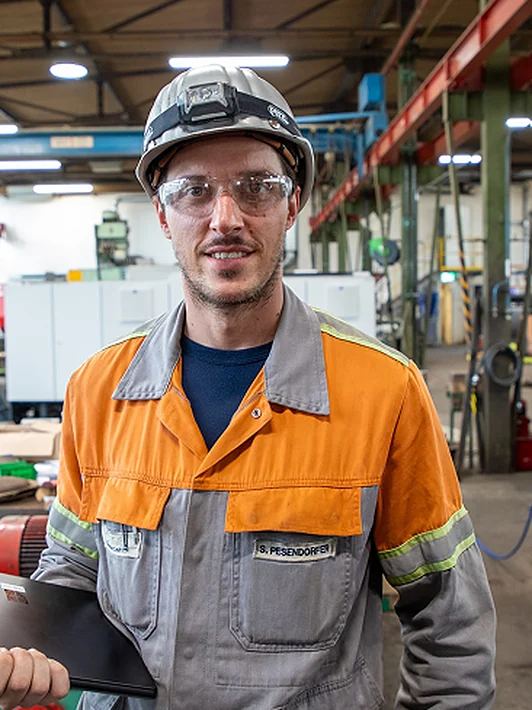
Pesendorfer is a process engineer. He has worked in maintenance for three years and has headed the whole of Central Maintenance, from the mechanical section to the vehicle fleet, since autumn 2025. His team grew out of large apprentice intakes: the average age is under 30, and the oldest are in their late thirties, yet counting their apprenticeships they already have 20 years of experience.
When Pesendorfer spoke about his maintenance department at the remberg Maintenance Summit in October 2026, he sat on stage alone, and the first thing he mentioned was his team. “Really, 59 other people should be up here too. It would certainly be more fun,” he said. “They’re the people on site who get the work done.”
For a long time, very little of what these people did was documented. The electricians used older maintenance software, but it was considered cumbersome and didn’t work on mobile devices. The mechanical fitters, the group Pesendorfer himself started out in, worked on paper. For a maintenance team in particular, a lack of documentation is a problem. “We don’t have a product,” says Pesendorfer. Unlike production, maintenance makes nothing that ends up being shipped, and its work mostly gets noticed when an asset breaks down. So Pesendorfer went looking for a way to make that work visible and easier to plan.

Maintenance is like oil in a gearbox. You shouldn’t be able to see it, but when it’s missing, it’s devastating.
Adopting existing processes instead of reinventing them
Pesendorfer had no wish to build his own solution again. Before he chose an off-the-shelf system, he had programmed an app himself. After that, it was clear to him: “I work in maintenance, I don’t need to develop processes from scratch. People at remberg have worked with thousands of maintenance people and taken the best from that. I build my process on top of theirs, and that made it easy.” To do that, he gave up his old workflow completely. In the customer video (in German), he sums it up in one sentence: “For me, remberg understands maintenance people.”
This reflects a belief he put into words at the Summit: whether it is a steel mill or the food industry, a maintenance process “works in a similar way. There’s a problem, and information has to be passed on to the next person.” That is why, for him, the test of good software is how reliably it records that information and hands it on to the next person. remberg came with these workflows already in place, from work request to work order to maintenance plan, without overloading the team with features.
Winning over the board first, then the team
Before the team could start working with remberg, Pesendorfer had to justify an investment in new software that had not been budgeted for. For him, that was the hardest part of the project, harder even than the rollout itself. He had only been head of the entire maintenance department for a few weeks, and on an earlier digitalisation project at the steel mill, by his own account, he had repeatedly hit a brick wall. He came away from it feeling “a bit burned”. Now he had to win approval for another maintenance system.
For the meeting with the board, he got a presentation, talking points and initial pricing from remberg. What tipped the balance, though, was a demonstration. Pesendorfer put a QR code in front of the board and had them report a fault on a smartphone themselves, just as everyone in the plant would later do. The work request went through so quickly that the board was convinced: the green light came shortly before Christmas, and the remberg project was under way by January.
Within the team, the electricians and the mechanical fitters approached the new software differently. The electricians were already familiar with maintenance software and quickly noticed how easy remberg is to use. According to Pesendorfer, shift electrician Martin Weinberger saw the benefits from day one. In the video, Weinberger explains what convinced him: “I like that it’s such an organic app. Whenever the developers bring out improvements, it never feels unfamiliar to me. You just carry on exactly as before.”
The fitters, who had worked on paper until then, first asked what they needed the software for. So for Pesendorfer, the key was “to show each person individually what they can get out of it, where the value is”. For some, the value lay in communication; for others, in clear work instructions: knowing what needs to be done and when the goal has been met.
Looking back, his advice to other maintenance managers who still have this kind of investment ahead of them is “to be brave. Just try it out, get to grips with it and question your own process too.”
From the QR code on the asset to the shift handover
What convinced the board is now part of everyday work across the plant. Anyone who spots a fault scans the QR code with their smartphone and submits a work request, with no user account and no download. “It just works, anyone can do it and everyone does,” says Pesendorfer.
Anyone who worked on an asset during the night records what they did in the work order, and in the morning everyone can read up on what happened. What Pesendorfer most enjoys reading is what Martin Weinberger has documented overnight. “I come into work and look through his work orders,” he says. “There’s always something good in there.” Take the time the hot water boiler had been repaired: the closing report noted, tongue in cheek, that colleagues could once again enjoy “a lovely warm shower”.

Key figures

100% of the team
report faults via QR code, with no login and no download

Around 3 weeks
from kick-off to working with the new process

Since January 2026
Central Maintenance has been working with remberg

What has changed in ten months
Documented at the asset instead of on paper
The fitters used to work on paper, and the electricians’ software didn’t work on mobile devices. Today, work is documented right at the asset. “Before remberg, a lot of things were very muddled,” says Weinberger. “Now, with remberg, we can document everything much better, with photos, log the spare parts and keep everything far more structured.”
The board can see what the team gets done
Something has changed further up the chain, too. When one of the key units runs into trouble, the board calls and wants to know what is going on. Pesendorfer then turns up with his tablet and goes through everything on the spot: what the team has done, backed up by photos, from the work request to the maintenance plan, all in one system. For a long time, maintenance work mostly got noticed when an asset broke down. Now everyone can see what the team does every day to keep the assets running.
At the end of the week, everyone can see what they’ve achieved
What Weinberger and his colleagues record helps not only the next shift but also the people who record it. Pesendorfer illustrates this with the fitters, who had initially asked what they needed the software for. One of them, he says, sees it like this: “At the end of the week, I can see what I’ve done.” Anyone who documents only on paper, or not at all, goes home on Friday knowing that the company is running, but not what they personally contributed. With remberg, a glance at their phone is enough. As Pesendorfer puts it, maintenance has no end and no fixed goal. That makes it all the more valuable to him to be able to set each person a small goal now and then, which also helps with motivation.
Old assets, new AI agents
The plant has dozens of assets from the 1960s and 1970s that are still a long way from the end of their service life. At the same time, Breitenfeld is often among the first to try new features: in early 2026, the team tested the prototype of the new mobile app, and in October Pesendorfer was already using the AI agents before their official launch. With them, he created a maintenance plan that he had been putting off since March. His verdict: “If I hadn’t had an agent, this maintenance plan wouldn’t exist yet either.”
In future, Pesendorfer wants to derive maintenance plans like this from the team’s own work order history, because the work orders show where the team has to step in again and again. That already works for the arc furnace; for other assets, there still isn’t enough data, even after ten months. “We really are coming out of the Stone Age, I mean the paper age,” he says. But the data grows with every documented work order, and so, alongside all the firefighting, the team is also getting its preventive maintenance done.
As Pesendorfer said, maintenance is never finished, but ten months in, a lot runs more smoothly. Planning and documentation still take time. Instead of hiring someone extra for that, he relies on digital support: “I’d rather have manpower at the machines and my digital assistant in my pocket.” After all, it is out at the assets that his people do the work that for so long hardly anyone saw. Today that work is visible, both to the board and to the team itself.